
How to write a sermon outline
A good outline is the bridge between your study and your preaching. It keeps the sermon faithful to the text, helps listeners follow along, and frees you to look up from your notes. Here’s a simple way to build one, step by step.
Published October 14, 2026 · About an 8-minute read
The steps at a glance
- Start with the text, not the outline
- Write the big idea in one sentence
- Choose a shape for the sermon
- Draw your main points from the passage
- Add support: sub-points, cross-references, illustrations
- Make the application concrete
- Write the introduction and conclusion last
- Check the length and prepare to preach
1. Start with the text, not the outline
It’s tempting to begin with three catchy points. Resist it. Read the passage several times, in more than one translation if you can, and read the chapters around it. Ask what the passage meant to its first readers before asking what it means for your church.
Write down what you notice: repeated words, contrasts, commands, questions, and the movement of the passage. These notes are the raw material your outline will come from.
2. Write the big idea in one sentence
Before you outline, try to say what the whole sermon is about in a single sentence. Many preachers call this the big idea, the main idea or the proposition. If you can’t say it in one sentence, the sermon probably isn’t clear yet, for you or for your listeners.
For Psalm 23, a big idea might be: “God provides for his people before they arrive.” Every point that follows should serve that sentence.
3. Choose a shape for the sermon
Let the passage suggest the structure. Some common shapes:
- Point by point (deductive): state the big idea, then unfold it in two to four points. Clear and easy to follow.
- Building to the point (inductive): raise a question or tension and let the passage answer it, stating the big idea near the end.
- Verse by verse: walk through the passage in order, drawing out the main idea of each section. Works well for narrative and for teaching series.
- Story (narrative): retell the passage’s story so listeners feel its turns before you apply it.
4. Draw your main points from the passage
Your main points should come from the text itself, ideally following its flow. Write each one as a full sentence, not a single word, so it says something. Two to four points is plenty for most sermons.
For Psalm 23, the psalm’s own movement gives three points:
- Point 1: The Shepherd leads (verses 1–3)
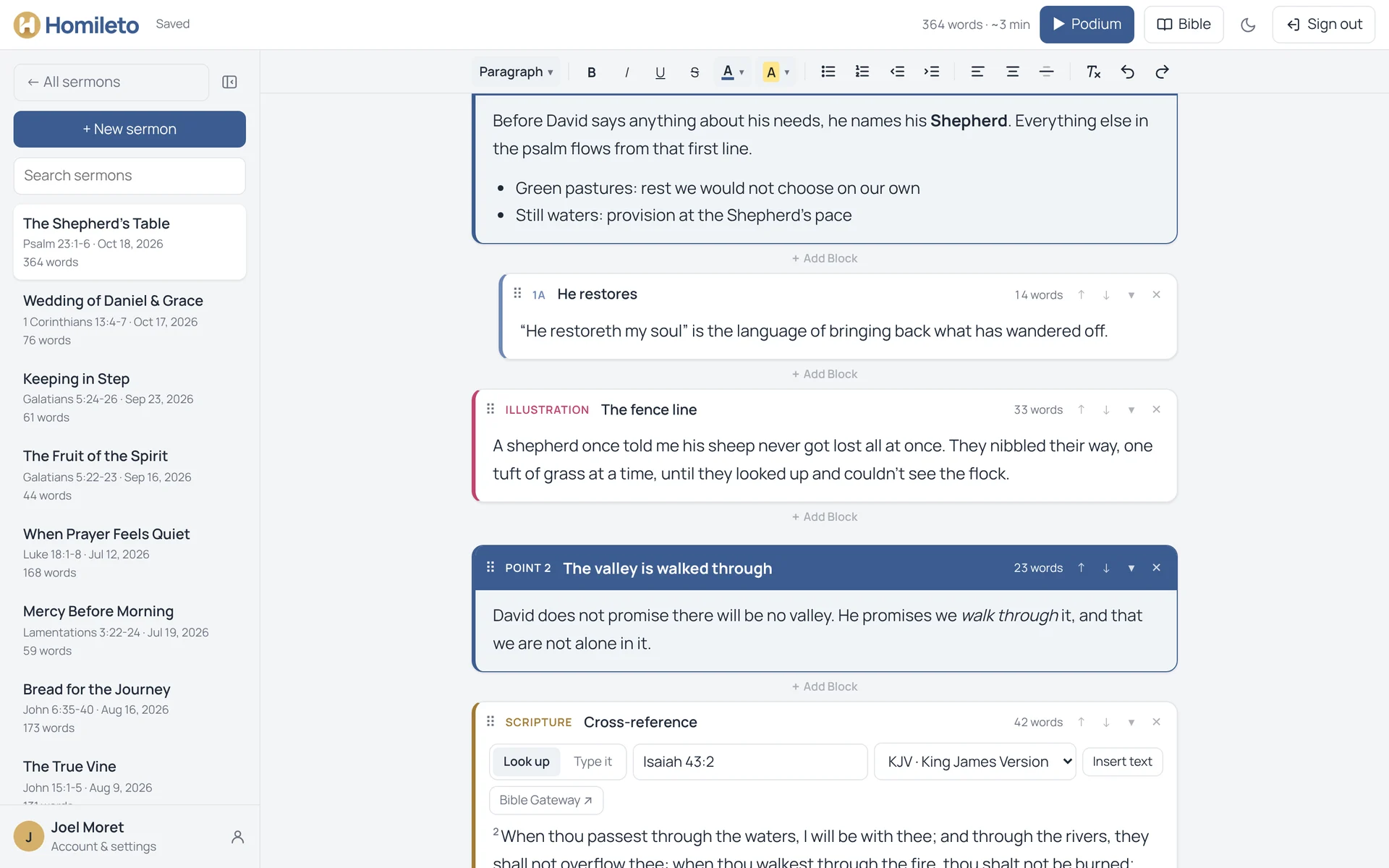
- Point 2: The valley is walked through (verse 4)
- Point 3: The table is already set (verses 5–6)
5. Add support under each point
Under each main point, add what will help people understand and believe it:
- Explanation: what the words mean, and the background your listeners need.
- Sub-points: smaller steps that unfold the main point, like “He restores” under Point 1.
- Cross-references: other passages that confirm or deepen the point (for Point 2, Isaiah 43:2).
- Illustrations: a story or image that makes the point concrete. One strong illustration usually beats three weak ones.
6. Make the application concrete
Ask: if someone believed this point, what would change on Monday? Specific application helps people act. “Trust God more” is hard to do. “Name one ‘valley’ you’re walking through and pray Psalm 23 over it each morning this week” gives them a next step.
You can apply as you go, after each point, or gather the application at the end. Either works; just make sure it’s there.
7. Write the introduction and conclusion last
Once you know where the sermon goes, you’ll know how to start it. A good introduction raises the question the sermon answers, or connects the passage to real life, in a minute or two. A good conclusion restates the big idea and leaves people with one clear thing to carry home. Don’t introduce new material at the end.
8. Check the length and prepare to preach
Many preachers speak at roughly 130 words a minute, so a 30-minute sermon is around 3,500 to 4,000 words of manuscript, or a much shorter outline if you preach from notes. Read it aloud once. Cut anything that doesn’t serve the big idea.
Then prepare the notes you’ll actually preach from: large type, points clearly marked, Scripture easy to find.
A sample outline: Psalm 23
Title: The Shepherd’s Table
Text: Psalm 23:1–6
Big idea: God provides for his people before they arrive.
- Introduction: Most of us know Psalm 23 from hospital rooms and funerals. David wrote it for ordinary days.
- 1. The Shepherd leads (vv. 1–3)
- Green pastures: rest we wouldn’t choose on our own
- Still waters: provision at the Shepherd’s pace
- Sub-point: He restores what has wandered off
- Illustration: sheep that nibble their way, one tuft at a time, until they’re lost
- 2. The valley is walked through (v. 4)
- No promise of no valley, but of company in it
- Cross-reference: Isaiah 43:2
- 3. The table is already set (vv. 5–6)
- The picture shifts from field to banquet: the Shepherd becomes the Host
- Application: Pray Psalm 23 over one “valley” each morning this week. Set a table for someone who needs to know they’re welcome.
- Conclusion: The table is ready before you arrive. Come and sit.
Building your outline in Homileto
Homileto is built around this way of working. Each part of your outline is a block: Scripture, Point, Sub-point, Illustration, Application or free Text. Points number themselves as you move them, the passage is one look-up away in a built-in Bible, and the word count and preaching time update as you write. When Sunday comes, Podium Mode turns the same outline into clean notes for the pulpit.